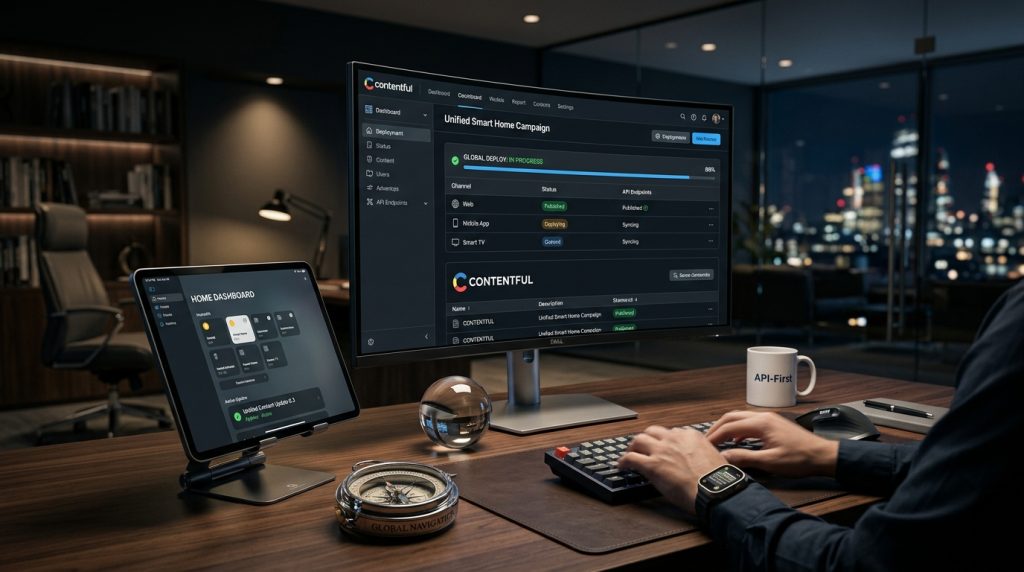
Contentful is one of the pioneers of the modern headless CMS movement. Since launching in 2013, it has become one of the most established platforms for teams building sophisticated content operations. Large enterprises use it. Major brands use it. It has grown from an interesting alternative to a mainstream enterprise choice.
For teams considering headless CMS approaches, Contentful represents the commercial polished option. It comes with the reliability, features, and support that enterprise buyers expect. It also comes with pricing that reflects its target market.
This piece covers what Contentful is, how it works, and when it makes sense to choose.
What Contentful Actually Is
The platform explained.
Cloud-Hosted Headless CMS
Contentful runs on their infrastructure. You do not host it. You subscribe and access it through their web interface and APIs.
API-First Architecture
Content lives in Contentful. Applications retrieve content through APIs. No built-in frontend.
Similar approach to other headless CMSs but with commercial polish.
Enterprise Focus
Contentful targets larger organizations. Feature set, pricing, and support reflect this.
Smaller projects can use free or entry-level tiers.
Content Modeling
Sophisticated content modeling capabilities. Content types, fields, relationships, references.
Multi-Channel Focus
Same content serves web, mobile, IoT, and other channels. Multi-channel content strategy is Contentful’s positioning.
How Contentful Works
The basic concepts.
Spaces
Top-level organization unit. A space contains all content for a project. Different spaces for different projects.
Content Types
Define the structure of your content. Article content type has fields for title, body, author, publish date, and so on.
Content Entries
Actual pieces of content. Each entry is based on a content type.
Assets
Images, videos, and files. Managed centrally.
Localization
Multiple languages supported. Content can have translations for each locale.
Environments
Different versions of content (production, staging, development). Deploy changes safely.
APIs
Content Delivery API for published content. Content Management API for editorial work. GraphQL API. Preview API for unpublished content.
Multiple APIs for different needs.
The Contentful Interface
Where editors work.
Web Application
Access Contentful through a web interface. Modern, polished, functional.
Content Editor
Rich editing interface for creating and updating content. Rich text, structured fields, media selection.
Media Library
Centralized management for images, videos, files.
Content Types Management
Interface for creating and modifying content types. Add fields, configure validations, set up relationships.
User Management
Manage team members and their permissions.
Extensions
Add custom functionality to the editing interface. Contentful supports app extensions.
Contentful’s Content Model
The organizing structure.
Content Type Design
Design content types thoughtfully. Fields for each piece of data. Validation rules. Relationships to other types.
Well-designed content models produce maintainable content operations.
Field Types
Short text, long text, rich text, number, boolean, date, location, media, references, JSON, and more.
Comprehensive field type coverage.
Validations
Fields can have validation rules. Required, minimum/maximum length, regex patterns, and others.
References
Content can reference other content. Articles reference authors. Products reference categories.
Single or multiple references.
Rich Text
Contentful’s rich text editor supports formatting, embedded entries, embedded assets, and inline links.
More sophisticated than simple text editing.
Contentful APIs
The developer interface.
Content Delivery API
Read published content. Optimized for delivery to applications. Fast.
Content Management API
Create, update, delete content programmatically. For automation and integrations.
GraphQL API
For teams preferring GraphQL. Query specific data efficiently.
Preview API
Access unpublished content for preview environments.
Images API
Transform images on the fly. Resize, crop, adjust quality, convert format.
Rate Limits
Different limits for different APIs and plans. Higher tiers have higher limits.
Contentful Pricing
The cost structure.
Free Plan
Limited functionality. Small team, limited content. Good for evaluation and small projects.
Community Plan
Free for small teams. Basic features. Limited scale.
Team Plan
Around $300 per month starting. For growing teams needing more capability.
Enterprise Plans
Custom pricing. Advanced features, higher limits, dedicated support.
The Reality
Contentful is expensive for enterprise use. Not the cheapest option in the headless CMS market.
The pricing reflects the target market and included features.
Contentful’s Strengths
Where it excels.
Polished Interface
The editing experience is refined. Non-technical content editors can work effectively.
Enterprise Features
Roles and permissions, workflow, environments, webhooks, comprehensive APIs. Enterprise needs supported.
Reliability
Established platform with strong uptime. Enterprise-grade infrastructure.
Scalability
Handles large content volumes and high traffic. Serious sites run on Contentful.
Multi-Language Support
Sophisticated localization. Content translated across locales.
Global CDN
Content delivered from edge locations globally. Fast retrieval.
Support
Enterprise support tiers available. Not just community support.
Contentful’s Challenges
The limitations.
Cost
Expensive relative to alternatives. Startup teams often find pricing prohibitive.
Vendor Lock-In
Content lives on Contentful’s infrastructure. Migration to other platforms is significant work.
Complexity for Simple Projects
Overkill for basic content needs. Simpler CMSs serve simple needs better.
Content Model Rigidity
Content models can be modified but with limits. Major restructuring is complex.
Development Requirements
Requires developer involvement. Frontend must be built. Not a complete solution alone.
Learning Curve
More to learn than simple CMSs. Content modeling concepts, APIs, and platform features.
When Contentful Fits Well
Situations that suit it.
Enterprise Content Operations
Large organizations with sophisticated content needs and budgets that support enterprise CMS pricing.
Multi-Channel Content
Content that appears across web, mobile, IoT, and other channels. Contentful excels at this.
Global Operations
Multi-language, multi-region content operations. Contentful’s localization is capable.
Development-Led Projects
Teams with development capacity building sophisticated applications.
Long-Term Enterprise Projects
Projects with long horizons where Contentful’s stability and support matter.
Content-First Businesses
Media companies, publishers, and content-focused businesses where content is the core product.
When Contentful Does Not Fit
Situations that suit alternatives.
Small Businesses
Small business marketing sites do not need Contentful’s capabilities or pricing.
Simple Content Sites
Blogs, basic company sites. Simpler CMSs serve these better.
Cost-Sensitive Projects
Startups, small teams, and projects with limited budgets. Contentful’s pricing is prohibitive.
Non-Technical Teams
Teams without development capacity struggle with headless approaches generally.
Fast Time-to-Market Priorities
Building headless applications takes time. Faster options exist for time-sensitive projects.
Contentful vs Alternatives
The competitive landscape.
Versus Strapi
Contentful is polished and hosted. Strapi is open-source and self-hostable.
Contentful is easier operationally. Strapi is more affordable and controllable.
Versus Sanity
Different data models. Sanity’s approach is more programmable. Contentful is more structured.
Both serve enterprise needs but differently.
Versus WordPress
Traditional CMS versus headless CMS. Very different approaches.
WordPress serves broader needs. Contentful serves specific headless needs.
Versus Directus & Others
Various open-source headless options. Contentful is polished commercial. Others provide alternatives with different trade-offs.
Building With Contentful
The workflow.
Content Modeling First
Design content types before adding content. Get the model right at the start.
Editorial Workflows
Establish how content moves from draft to published. Who reviews what. When things get scheduled.
API Integration
Frontend developers integrate Contentful APIs into applications. Fetch content, render appropriately.
Caching Strategy
APIs are fast but caching improves performance further. Static generation, CDN caching, application caching.
Deployment Considerations
Changes to content types can affect existing content. Deploy changes thoughtfully.
Contentful for Different Use Cases
Where it fits.
Enterprise Marketing Sites
Large marketing operations with sophisticated content needs.
E-commerce Content Layers
Contentful serving product content, marketing content, editorial content alongside e-commerce platforms.
Media Publications
News, magazines, publishers needing sophisticated content management with modern delivery.
SaaS Application Content
Marketing sites, documentation, help centers for SaaS products.
Multi-Brand Operations
Managing content for multiple brands under one organization.
Development Considerations
Building with Contentful.
SDKs & Libraries
Contentful provides SDKs for popular languages and frameworks. JavaScript, React, Next.js, iOS, Android.
Framework Integration
Popular integrations with Next.js, Gatsby, Nuxt.js, and other modern frameworks.
Preview Environments
Set up preview environments so editors can see unpublished changes.
Webhooks
Contentful can send webhooks on content changes. Trigger rebuilds, notifications, integrations.
Testing
Testing content-driven applications requires thought. Mock content for tests. Preview environments for editorial review.
Common Contentful Considerations
Things to think about.
Content Model Evolution
How content models change over time. Backward compatibility. Migration strategies.
Cost Management
API call limits, content limits, user limits. Monitor usage. Optimize where possible.
Team Onboarding
Getting new team members productive on Contentful. Documentation, training, workflows.
Backup & Data Export
Export capabilities for backup and portability. Important for disaster recovery and platform independence.
Security
Access control, API key management, sensitive content handling.
Contentful’s Ecosystem
The support structure.
App Marketplace
Extensions and integrations available. Extend Contentful’s functionality.
Partner Network
Consulting partners and implementation partners. Get help from experienced Contentful implementers.
Community
Active community. Forums, Slack, events.
Learning Resources
Documentation, tutorials, courses. Well-supported learning materials.
Support Tiers
Community support for basic tiers. Enterprise support for enterprise plans.
Migration Considerations
Moving in or out.
Migrating to Contentful
Content can be imported from various sources. Custom scripts often required for specific source formats.
Migrating From Contentful
Content can be exported through APIs. Migration to another platform requires rebuilding content operations elsewhere.
Vendor lock-in is real. Plan carefully.
Long-Term Commitment
Choosing Contentful is a significant commitment. Long-term projects benefit. Short-term projects may not justify the setup work.
The State of Contentful Today
Current situation.
Established Platform
Well-established with major enterprise customers. Financial stability. Continued investment.
Feature Development
Regular feature releases. Platform continues to evolve.
Market Position
One of the top three or four headless CMS platforms globally. Strong position.
Long-Term Viability
Not going away. Enterprise customers depend on it. Investment continues.
Closing Thoughts on Enterprise Headless CMS
Contentful is a legitimate choice for enterprise headless CMS needs. The polish, features, and support fit organizations with sophisticated requirements and budgets to match.
For enterprise operations that fit Contentful’s target market, it produces excellent results. Content operations scale. Multi-channel content works. Developer teams have what they need.
For smaller operations, the pricing and complexity may not fit. Alternatives serve better for cost-sensitive or simpler needs.
For teams evaluating headless CMS options, Contentful represents the premium commercial choice. Compare its advantages against alternatives like Strapi, Sanity, and others.
For projects that need what Contentful offers, the cost is worth it. For projects that do not need the enterprise features, the cost is not justified.
The learning investment is real but manageable. Teams become productive with reasonable time.
The vendor lock-in is real. Migration away is significant work. This commitment matters for long-term planning.
The polish that Contentful provides has genuine value. Content editors work effectively. Developers have good tools. Operations run reliably.
For enterprises with content-focused operations, Contentful deserves serious consideration. The capabilities align with enterprise needs.
For teams choosing between Contentful and open-source alternatives, evaluate trade-offs honestly. Cost. Control. Operational complexity. Support needs. Each factor matters for different organizations.
For teams considering Contentful specifically for headless architecture, ensure headless is really needed. Traditional CMSs work well for many projects. Do not choose headless because it seems trendy.
Contentful serves the enterprise headless CMS market well. It has earned its position through years of development and customer success.
For projects that fit that market, Contentful is worth the investment. For projects that fit other markets, other platforms probably serve better.
Choose based on your specific needs, not just Contentful’s reputation. When your specific needs align with what Contentful specifically offers, it becomes an excellent choice. When they do not, other platforms become better choices.
For enterprise operations building sophisticated content-driven applications, Contentful provides a platform that scales with the business. The investment produces returns through operational efficiency and technical capability.
For smaller operations or simpler projects, choose simpler platforms. Not everything needs enterprise CMS capabilities.
Take the time to evaluate what your project actually needs. Match platform to needs rather than selecting based on prestige or marketing. The right platform is the one that fits your specific situation and enables your specific work. When that platform is Contentful, use it well and take advantage of what it offers. When it is not, choose alternatives that better fit your specific requirements. Either way, focus on building great content operations that serve your organization well, supported by whichever platform best fits your specific situation.