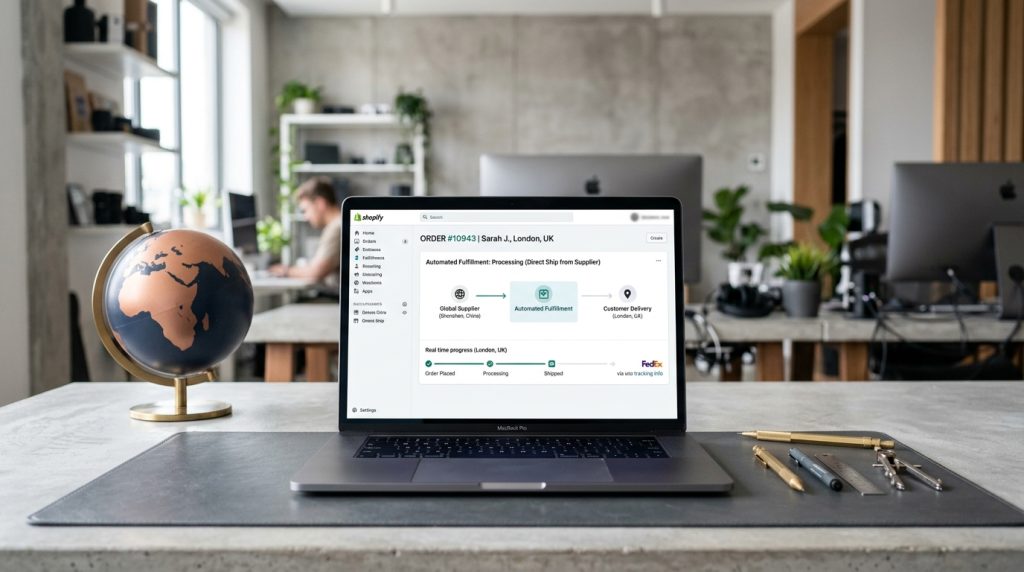
Dropshipping is a business model where you sell products without ever holding inventory. Customers order from your store. You forward the order to a supplier. The supplier ships directly to the customer. You never see the physical product.
The appeal is obvious. Low startup costs. No inventory investment. No warehousing. Ability to test products without commitment. Businesses can launch with minimal capital.
The reality is more nuanced. Dropshipping is real but has significant challenges. Understanding what dropshipping actually involves helps you decide if it fits your situation and how to approach it if you do proceed.
This piece covers what dropshipping is, how it works with Shopify, and what to know about running a dropshipping business successfully.
What Dropshipping Actually Involves
The basic model.
The Transaction Flow
Customer places an order on your Shopify store. You collect payment. You place an order with your supplier for the same product, shipped to the customer’s address. The supplier ships the product. Customer receives the product.
You keep the difference between what the customer paid and what you paid the supplier.
Your Role
You handle marketing, sales, customer service, and platform management. You never touch the physical products.
The Supplier’s Role
Suppliers hold inventory, process orders you send them, and ship to your customers.
The Middleman Position
You are essentially a middleman. You add value through marketing, customer experience, and curation. But you do not add manufacturing or logistics value.
Why Dropshipping Appeals
The advantages are real.
Low Startup Costs
No inventory investment. No warehouse. No shipping infrastructure. You can start with a Shopify subscription and marketing budget.
Low Financial Risk
You do not buy products until customers order them. No leftover inventory. No inventory obsolescence.
Product Testing Flexibility
Try selling different products without committing to inventory. If something does not sell, move on with no loss.
Location Independence
You can run a dropshipping business from anywhere with internet. No physical operations to tie you to a location.
Scalability
Adding more products or handling more orders does not require proportional investment in physical infrastructure.
The Realities of Dropshipping
The challenges are also real.
Thin Margins
Suppliers charge dropshippers relatively high per-unit prices because volume is unpredictable. Your margins get squeezed.
Advertising costs eat into thin margins. Profitability requires careful attention.
No Inventory Control
Suppliers may run out of stock without warning. Your store shows products as available that suppliers cannot deliver.
No Quality Control
You never see products before they ship. Quality issues fall on you. Angry customers come to you, not the supplier.
Slow Shipping
Especially for suppliers overseas. Long shipping times frustrate customers used to fast delivery.
Complicated Returns
Handling returns for products you never touched creates logistics challenges.
Competitive Pressure
Dropshipping is popular. Many other people sell the same products from the same suppliers. Competition is intense.
Brand Building Difficulty
Building a distinctive brand when selling the same products as many others is challenging.
Types of Dropshipping
Not all approaches are the same.
General Dropshipping (AliExpress & Similar)
Traditional model. Suppliers in China (often through AliExpress). Cheap products. Long shipping. Variable quality.
Low barriers to entry. Low margins. High competition.
Print-on-Demand
Custom-designed products (t-shirts, mugs, phone cases) printed only when ordered. Suppliers like Printful and Printify handle production.
Slightly higher margins than general dropshipping. Design-focused business.
US-Based Suppliers
Suppliers with US inventory. Faster shipping (2-7 days). Higher costs but better customer experience.
Reduces main dropshipping downsides at cost of margins.
Private Label Dropshipping
Working with suppliers to add your brand to products. Slightly higher barriers but better differentiation.
Wholesale Dropshipping
Working directly with wholesalers who dropship. More professional relationships. Better products typically.
Popular Dropshipping Apps
Tools that connect suppliers to Shopify.
DSers
Popular for AliExpress-based dropshipping. Automates order processing between Shopify and AliExpress suppliers.
Free and paid plans.
Spocket
Focuses on US and European suppliers. Faster shipping than AliExpress-based options.
Paid subscription. Higher-quality suppliers.
Printful
Leading print-on-demand service. High-quality products. Automated fulfillment.
Various pricing based on products.
Printify
Similar to Printful. Wider network of print providers. Sometimes lower costs.
Modalyst
US-based suppliers focused on higher-quality products.
AutoDS
Automation platform for various dropshipping models.
CJ Dropshipping
Direct sourcing from Chinese suppliers with better prices than AliExpress but similar shipping times.
Setting Up a Dropshipping Store
The process.
Choose a Niche
Do not try to sell everything. Pick a specific niche where you can develop expertise and target marketing.
Broader stores struggle to build brand identity. Focused stores build customer bases.
Find Products
Research products in your niche. Verify supplier reliability. Order samples to check quality yourself.
Do not sell products you have not verified.
Set Up Shopify
Standard Shopify setup. Choose a theme. Configure basics. Add pages.
Install Dropshipping App
Choose the appropriate app for your supplier situation. Connect it to your store.
Import Products
Import products from suppliers through the app. Rewrite descriptions in your own words. Do not just import supplier text.
Configure Pricing
Set your pricing. Cover product cost, shipping cost, transaction fees, and desired margin. Include advertising cost in your calculations.
Configure Shipping
Set customer-facing shipping rates based on what suppliers charge. Some businesses offer free shipping (built into product price).
Set Up Payment
Standard Shopify Payments setup. Test the flow.
Test the Full Process
Order from yourself. Verify the supplier processes the order. See how long shipping takes. Check quality.
Marketing Dropshipping Stores
The main work.
Paid Advertising
Most dropshipping stores rely on paid advertising. Facebook, Instagram, TikTok, Google. Getting customers costs money.
Understanding cost per acquisition and lifetime value is essential.
Social Media Content
Organic social media content for niche audiences. Long-term but sustainable if you build followers.
Influencer Marketing
Working with influencers relevant to your niche. Effective for many product categories.
SEO
Building organic search traffic through content. Slower but sustainable. Especially useful for niche products.
Email Marketing
Building email lists and marketing to existing customers. Essential for profitability.
Common Dropshipping Mistakes
New dropshippers stumble in predictable ways.
Selling Everything
Wide product ranges without focus. Cannot build brand identity or marketing focus.
Not Verifying Suppliers
Trusting suppliers without ordering samples or verifying reliability. Then facing quality problems that alienate customers.
Ignoring Shipping Times
Selling products with 30-day shipping without communicating clearly. Angry customers when products do not arrive quickly.
Poor Customer Service
Customer complaints get ignored because you cannot control the fulfillment. Damages reputation.
Copy-Paste Descriptions
Using supplier descriptions without modification. Bad for SEO and looks unprofessional.
Insufficient Testing
Launching products without ordering them yourself. Then customers experience problems you did not know about.
Weak Margins
Not accounting for all costs. Then wondering why the business is not profitable.
Copying Other Stores
Just copying what successful dropshippers do without adaptation. Market saturation results.
What Makes Some Dropshipping Businesses Succeed
Common patterns in successful stores.
Niche Focus
Deep expertise in a specific market. Marketing directly to that audience. Products that fit the niche.
Quality Suppliers
Working with better suppliers even at higher costs. Quality products with reasonable shipping produce satisfied customers.
Strong Marketing
Effective advertising with good creative. Understanding of what works for the audience.
Customer Service Investment
Responsive customer service that handles issues professionally. Turns potential negative reviews into satisfied customers.
Brand Building
Building an actual brand rather than just reselling products. Distinctive identity and voice.
Product Selection Discipline
Only selling products the entrepreneur has actually verified. Removing products that create problems.
Realistic Expectations
Not treating dropshipping as easy money. Recognizing it as a real business requiring real work.
When Dropshipping Makes Sense
Situations that fit the model.
Testing Market Fit
Testing product ideas before committing to inventory. Dropshipping is faster and lower-risk for validation.
Very Low Startup Capital
If you truly have no capital for inventory, dropshipping is a way to start.
Print-on-Demand for Creators
Artists, designers, and creators using print-on-demand for their designs. Excellent fit.
Complementary to Own Products
Adding related products through dropshipping to complement products you actually stock.
When Dropshipping Does Not Fit
Situations that do not.
Serious Long-Term Business Building
Building a distinctive brand and long-term business often works better with actual inventory or manufacturing.
High-Margin Product Categories
Products with good margins usually work better with inventory. Better control, better margins, better customer experience.
Premium Positioning
Premium brands need control over quality and customer experience. Dropshipping limits this.
Fast Shipping Expectations
Categories where customers expect fast shipping do not fit dropshipping unless suppliers can meet those expectations.
Closing Thoughts on the Dropshipping Model
Dropshipping is a legitimate business model that has helped many people start online businesses without significant capital. But it comes with challenges that new entrepreneurs often underestimate.
For most people considering dropshipping, understanding the realities matters more than the marketing hype. Dropshipping is not passive income. It is not easy money. It is a real business with real challenges.
The businesses that succeed at dropshipping treat it as a real business. Real marketing effort. Real customer service. Real brand building. Real quality control at the supplier level. The businesses that treat it as easy money mostly fail.
For entrepreneurs with limited capital who want to try e-commerce, dropshipping provides a starting point. Low financial risk. Fast to launch. Room to learn while building.
For businesses that grow beyond initial testing, transitioning to holding inventory or manufacturing often produces better results long-term. Better margins, better control, stronger brand potential.
Print-on-demand deserves separate consideration. For artists, designers, and creators, it is often a better fit than general dropshipping. Custom products with brand association work differently from generic dropshipped goods.
For businesses considering dropshipping, be realistic about what it involves. Do the research. Verify suppliers. Test products. Build proper systems. Treat it like a real business from the start.
The dropshipping model works when applied thoughtfully with realistic expectations. It does not work as a get-rich-quick scheme. The businesses that treat it as legitimate entrepreneurship can build meaningful operations. The businesses that treat it as easy money mostly disappoint themselves.
If you decide to proceed with dropshipping, put in the work required for any real business. Marketing. Customer service. Continuous improvement. The tools like Shopify and dropshipping apps make the operational side easier than it used to be. But the business work still needs to happen. Do that work, and dropshipping can produce meaningful results. Skip the work and expect success, and disappointment will follow.