Product videos have become one of the most effective tools in e-commerce. Videos convey what photos and text cannot. Motion. Scale. Function. Context. Customers watching product videos develop stronger understanding of what they are considering buying, which translates to higher conversion rates.
The barrier to creating product videos has dropped significantly. Smartphones shoot high-quality video. Editing software is accessible. Distribution through product pages, social media, and email is straightforward. What was once expensive and complex is now achievable for businesses of most sizes.
This piece covers why product videos matter, what makes them effective, and how to create them without significant investment.
Why Product Videos Work
The impact is concrete.
Higher Conversion Rates
Product pages with video convert better than product pages with only photos. The improvement varies but is consistently positive.
Better Product Understanding
Videos show products in ways photos cannot. Motion, scale, function all come through more clearly.
Reduced Returns
Customers who see products in video know what they are buying. Fewer surprises upon delivery.
Time on Page
Videos increase time spent on product pages. Engagement signals help SEO.
Mobile Engagement
Mobile users engage strongly with video. Growing share of e-commerce is mobile.
Social Media Distribution
Videos perform well on social platforms. Same content works across product pages and social channels.
Trust Building
Video builds trust more than text or photos alone. Seeing the product feels more real.
Types of Product Videos
Different formats serve different purposes.
Product Showcase Videos
Product from multiple angles with clean presentation. Similar to product photos but with motion. Basic and effective.
Product Demonstration Videos
Product being used. Shows function and results. Answers “how does this work” questions.
Lifestyle Videos
Product in context of use. Home, outdoor, work. Helps customers imagine ownership.
How-To Videos
Instructions for using the product. Answers pre-purchase questions about ease of use.
Comparison Videos
Product compared to alternatives. Positions product against competition.
Testimonial Videos
Real customers talking about the product. Powerful social proof.
Story Videos
Behind the scenes, brand story, craftsmanship. Builds brand connection.
Unboxing Videos
The unpackaging experience. Sets expectations for what customers will receive.
Where to Use Product Videos
Distribution matters.
Product Pages
The primary location. Embed videos on product pages where customers make purchase decisions.
Category Pages
Videos in category displays help customers preview products.
Homepage
Feature videos on homepage draw attention to specific products.
Email Marketing
Video thumbnails in emails increase click-through rates significantly.
Social Media
Same videos work on Instagram, TikTok, Facebook, YouTube.
Paid Advertising
Video ads on social platforms and YouTube perform strongly.
Retail Displays
For businesses with physical presence, videos on tablets or displays.
Equipment for Product Videos
Getting started.
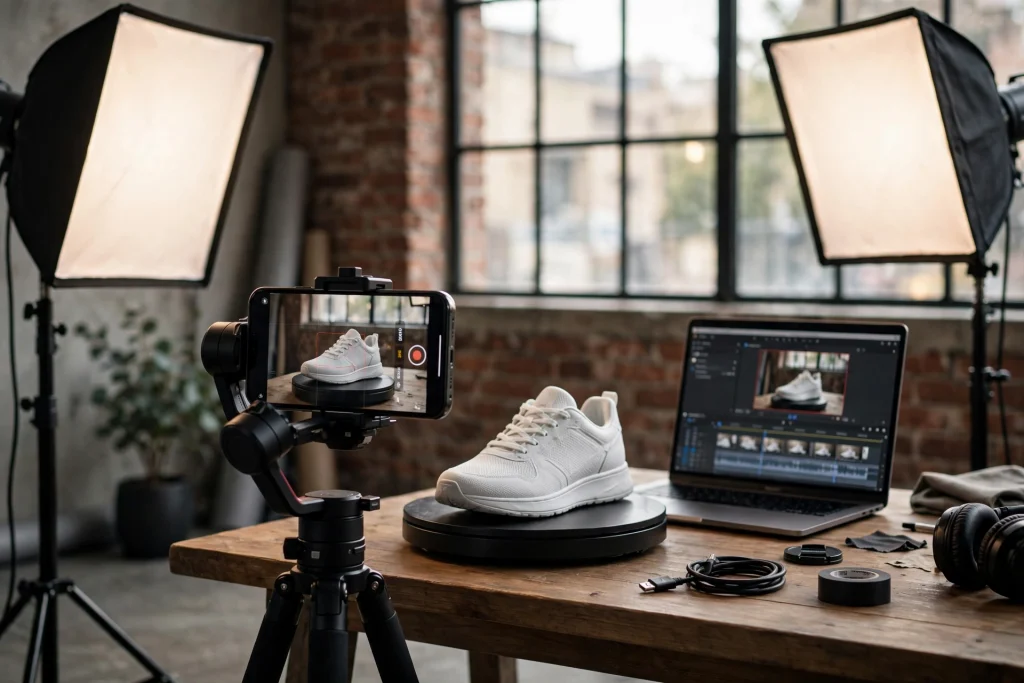
Smartphone
Modern iPhones and high-end Android phones shoot excellent 4K video. Sufficient for most needs.
Tripod
Stability matters even more for video than photos. Get a decent tripod.
Basic Lighting
Same lighting principles as photography apply. Continuous lighting works well for video.
Microphone
For videos with sound, external microphone significantly improves audio quality.
Lavalier microphones for people talking. Shotgun mics for other situations.
Editing Software
Free options: iMovie (Mac), DaVinci Resolve, CapCut.
Paid options: Adobe Premiere Pro, Final Cut Pro.
Advanced Equipment
Dedicated cameras. Stabilizers. Extensive lighting. Professional microphones.
Not required to start but useful as you scale.
Planning Your Product Videos
Preparation matters.
Video Purpose
What should this video accomplish? Show product function? Demonstrate results? Provide context? Different purposes require different videos.
Target Audience
Who is watching? Their questions and concerns drive video content.
Key Messages
What must the video communicate? Not everything, just the key points.
Length
Short is usually better for product videos. 30 seconds to 2 minutes for most products.
Style
Match brand identity. Casual? Professional? Playful? Consistent across videos.
Script or Outline
Even short videos benefit from planning. What will you show? What will you say?
Shooting Product Videos
The production.
Consistent Lighting
Same lighting throughout. Avoid changes that make video feel disjointed.
Steady Camera
Tripod or gimbal. Handheld footage looks amateurish for product videos.
Multiple Angles
Shoot multiple angles. Provides options in editing.
B-Roll
Additional footage for cutaways. Detail shots. Product close-ups. Adds interest to videos.
Clean Audio
If videos include speech, clean audio matters. Quiet space. Good microphone.
Multiple Takes
Shoot multiple takes of each segment. Choose best in editing.
Slow Movements
For product motion, slow deliberate movements look better than quick jerky motion.
Editing Product Videos
Post-production.
Cutting to Length
Tighten aggressively. Remove anything that does not add value.
Transitions
Simple cuts work for most product videos. Fancy transitions distract.
Text Overlays
Product name. Key features. Prices. Text supports what customers see.
Music
Background music adds energy. Choose royalty-free tracks that fit brand.
Sound Effects
Product sounds can be effective. Camera sounds. Product operation sounds.
Color Correction
Consistent color across the video. Products should look accurate.
Export Settings
High quality for web display. Not so large that they slow page loading.
Product Showcase Videos
The basic format.
Rotating Product
Product on turntable rotating slowly. Shows all angles. Simple but effective.
Multi-Angle Video
Different shots showing product from different angles. Edited together.
Detail Focus
Close-ups of features. Show craftsmanship or design details.
Length
Usually short. 15-30 seconds. Just enough to show the product completely.
Product Demonstration Videos
Showing function.
Product in Use
Real usage. Not sped up or dramatized. Shows what customers will experience.
Before & After
For products with results. Cleaning products, beauty products, tools.
Step by Step
For products requiring setup or use. Show the process clearly.
Real Environments
Kitchen, garage, workshop, wherever the product would actually be used.
Length
Usually 30 seconds to 2 minutes. Long enough to show the function completely.
Lifestyle Videos
Context matters.
Product in Setting
Product in home, outdoor, work, or other setting where it would be used.
People With Product
Real people using the product. Not necessarily models.
Emotional Connection
Show what the product enables. The lifestyle, not just the object.
Brand Positioning
Lifestyle videos position products within lifestyles brands want to associate with.
Length
Usually 30 seconds to 1 minute.
Video for Social Media
Different requirements.
Aspect Ratio
Instagram and TikTok prefer vertical (9:16). YouTube prefers horizontal (16:9). Facebook and Instagram feed use square (1:1).
Shoot in higher resolution to allow cropping for different formats.
Attention Grabbing
Strong opening in first 3 seconds. Social users scroll past quickly.
Captions
Many watch social video with sound off. Captions matter.
Length
Shorter for social. 15-30 seconds often. TikTok can be longer for engaging content.
Native Uploads
Upload directly to each platform rather than linking. Better engagement.
Videos in Email Marketing
Effective distribution.
Video Thumbnails
Actual video does not embed well in email. Use thumbnail image linking to video.
Play Button Overlay
Add play button overlay on thumbnail. Signals video.
GIF Alternatives
Short GIFs can preview video motion in email.
Landing Page
Video plays on landing page. Track engagement.
Subject Lines
“Video” in subject lines often increases open rates.
YouTube Considerations
The video platform.
SEO Value
YouTube is the second largest search engine. Product videos rank there.
Video Descriptions
Written descriptions provide SEO value. Include keywords, link to product page.
Thumbnails
Custom thumbnails increase click-through. Design thumbnails carefully.
Playlists
Group related videos into playlists. Increases viewing time.
Community Building
YouTube channels build subscriber bases. Long-term audience asset.
Video Performance Measurement
Tracking what works.
View Counts
How many people watched. Basic engagement metric.
View Duration
How long they watched. Reveals whether content held attention.
Engagement
Likes, comments, shares. Community response.
Conversion Impact
Do product pages with video convert better than without? A/B testing reveals impact.
Click-Through
For videos in email or social, how many clicked to product pages.
Cost per Conversion
For paid video ads, cost to acquire customers through video.
Common Video Mistakes
Where businesses stumble.
Poor Audio
Bad audio ruins even good video. Invest in audio quality.
Too Long
Videos that lose viewers before making key points.
Weak Opening
Slow starts lose viewers in first 3 seconds.
No Clear Message
Trying to communicate too much. Focus each video.
Poor Lighting
Dim or harsh lighting looks amateurish.
Distracting Backgrounds
Cluttered backgrounds pull attention from products.
Bad Editing
Rough cuts, jarring transitions, awkward pacing.
No Call to Action
Videos without clear next step. Customers watch and do nothing.
Wrong Aspect Ratio
Videos formatted for wrong platform. Cut off or awkward on target platform.
Ignoring Mobile
Videos not optimized for mobile viewing where most viewing happens.
Video Optimization for Product Pages
Technical considerations.
File Size
Compress for web delivery. Balance quality with load time.
Loading Strategy
Videos should not slow initial page load. Lazy load below the fold.
Autoplay Considerations
Muted autoplay works. Unmuted autoplay annoys.
Poster Images
Custom poster image before video plays. Shows what to expect.
Multiple Formats
MP4 is standard. Some platforms support additional formats.
CDN Delivery
Video CDNs speed delivery. Services like Vimeo, Wistia, or YouTube handle this.
Building Video Production Systems
Consistency over time.
Documented Process
Document your video creation process. Consistent quality across videos.
Templates
Editing templates ensure consistent style.
Batch Production
Shoot multiple videos in one session. More efficient than individual sessions.
Content Calendar
Plan video content in advance. Not reactive one-offs.
Team Roles
If team involved, define roles. Who shoots. Who edits. Who publishes.
Learning & Improvement
Study what works. Iterate on approach. Skills develop over time.
When to Invest in Professional Video
Beyond DIY.
Hero Videos
Main brand videos deserve professional production. High visibility.
Advertising
Paid video ads justify professional production. ROI drives the investment.
Complex Products
Products requiring sophisticated demonstration benefit from professional expertise.
Established Brand
Successful businesses can afford professional video. Higher production values match brand positioning.
Video-Focused Brands
If video is central to marketing, professional production pays back.
Closing Thoughts on Video Marketing Impact
Product videos are one of the higher-impact investments in e-commerce marketing. The technology has become accessible. The distribution channels have become plentiful. The impact on conversions is measurable.
For most e-commerce businesses, product videos are no longer optional. Customers expect them. Competitors provide them. Not having product videos disadvantages your store.
For businesses just starting with video, DIY approach with smartphone and basic equipment works. Better to have good videos than none.
For businesses with some experience, systematic improvement produces better results. Better equipment. Better technique. Better content.
For businesses ready for professional production, the investment produces returns for hero content, advertising, and brand building.
The distribution across product pages, social media, email, and advertising means one video can serve multiple purposes. Investment in video content is efficient because of this multi-channel usage.
For businesses with limited resources, prioritize videos that will serve multiple purposes. Product demonstrations that work on product pages, in ads, and on social media provide more value than videos limited to one channel.
For businesses with more resources, video content strategy becomes worth planning. What videos to create. In what order. For which channels.
The compound effect of video content grows over time. Videos created today continue driving traffic and conversions months and years later. This makes video investment produce ongoing returns.
For businesses that have avoided video due to perceived complexity, the barrier is lower than it seems. Modern tools make video production accessible.
For businesses already doing video, continuous improvement produces continuous gains. Better quality. More types of content. More effective use.
Take product videos seriously as marketing assets. They convey what other media cannot. They engage customers in ways photos cannot. They convert better than text alone.
The customer experience of considering a product is significantly better with good video. Understanding function. Seeing scale. Appreciating quality. Video communicates these things effectively.
For products that benefit from motion or demonstration, video is particularly valuable. For all products, at least basic showcase videos improve product pages.
The e-commerce market increasingly expects video. Businesses that provide it are better positioned than those that do not. The investment in video capabilities pays back through improved sales performance across the entire product catalog.
Video changes how customers experience your products before they buy. Making that experience compelling is one of the most impactful things you can do for your e-commerce business. Take the time to develop video capabilities, and every product benefits from the video content that supports it. The results appear in conversion rates, average order values, and customer satisfaction over time.